
One Song, Two Truths: How Heated Rivalry Transforms “All The Things She Said”
Breaking Down the Dual Use of “All The Things She Said” in Episode 4 of Heated Rivalry
STAFF
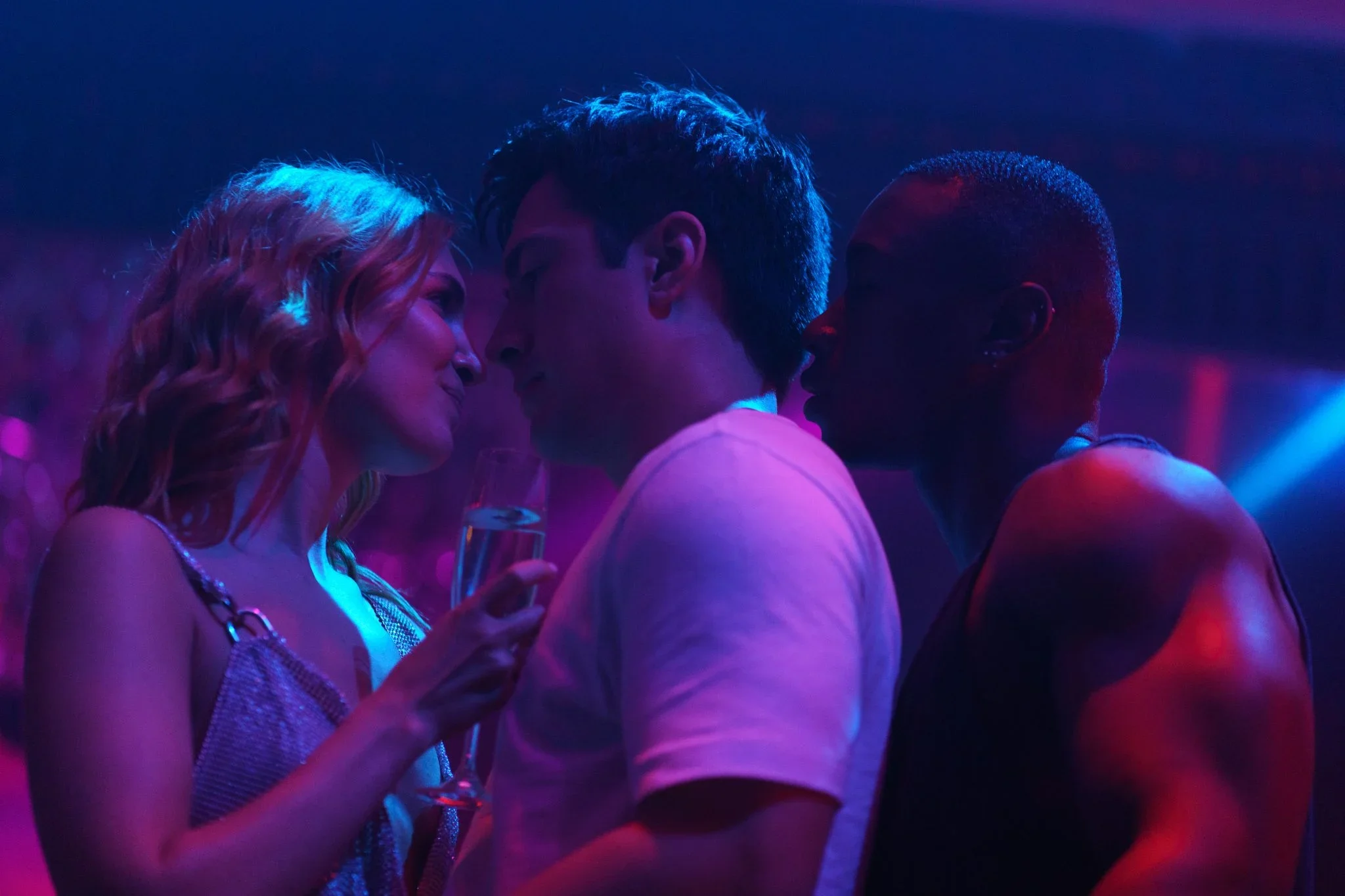
Image courtesy of Crave / Bell Media
There are songs that soundtrack a scene — and then there are songs that interrogate it.
In Episode 4 of Heated Rivalry, titled “Rose,” one track quietly becomes the episode’s emotional backbone. “All The Things She Said” appears twice: first in its original form by t.A.T.u, then later in a distorted, slowed reinterpretation by Harrison. The repetition is deliberate. Between those two moments, the meaning of the song, and the emotional reality of the characters, fundamentally changes.
What begins as adrenaline-fuelled desire ends as something far lonelier, more fractured and harder to sit with. And the transformation happens almost entirely through sound.
The first time we hear “All The Things She Said,” it’s loud, kinetic and uncontained. The setting is a nightclub — bodies packed together, lights flashing, movement constant. Shane dances intimately with Rose, the moment charged with anticipation and physical closeness. The song’s urgent beat mirrors the immediacy of the scene: this is desire lived in the present tense.
Across the room, Ilya watches.
He dances with another woman, but his attention drifts elsewhere. He is physically present but emotionally removed, caught in the space between wanting and restraint. The original t.A.T.u version of the song thrives in this environment — dramatic, impulsive, driven by the thrill of what might happen next.
Here, longing is public. It’s loud enough to drown out doubt. The pain embedded in the lyrics feels secondary to the rush of anticipation, to the promise of intimacy that feels just within reach.
By the end of the episode, “All The Things She Said” returns — but it barely resembles itself.
Harrison’s version is slower, warped and emotionally exposed. The beat no longer propels the moment forward; instead, it stretches time, creating space for discomfort to surface. As it plays, Shane and Rose are in a bedroom, finally acting on the tension built earlier in the night.
But this doesn’t feel like release.
Running parallel, Ilya is alone in a shower, pleasuring himself in isolation. The contrast is stark and intentional: intimacy and solitude unfolding simultaneously, bound together by the same song yet experienced entirely differently.
The distortion in Harrison’s rendition mirrors the emotional distortion of the moment. What once felt electric now feels unresolved. The lyrics linger rather than rush. The music doesn’t heighten excitement — it exposes absence.
Using the same song twice is not a stylistic coincidence. It’s an emotional device.
In the nightclub, “All The Things She Said” represents anticipation — desire amplified by noise, movement and the presence of others. In the bedroom and the shower, it becomes about aftermath — about what desire looks like once it’s acted upon, or worse, left unfulfilled.
The song doesn’t change its words. The context changes its truth.
One version is about wanting. The other is about realizing what wanting costs.
Heated Rivalry doesn’t rely on dialogue to explain this shift. It trusts the audience to feel it. The music does the emotional translation work, articulating what the characters themselves cannot yet confront.
This is where the episode becomes quietly devastating. Sex does not equal connection. Proximity does not guarantee relief. And sometimes, the most painful version of desire is not the one that goes unmet — but the one that’s partially fulfilled and still leaves something aching.
By ending the episode with Harrison’s interpretation, the show refuses easy closure. Instead, it leaves us suspended in that unresolved emotional space, where longing lingers and clarity remains just out of reach.
“All The Things She Said” becomes more than a soundtrack choice in Episode 4 — it becomes a thesis. Desire can be euphoric. It can also be isolating. And the difference between the two is often revealed not in what happens, but in how it feels afterward.
By replaying the same song in two radically different emotional contexts, Heated Rivalry asks the audience to sit with that discomfort — and to recognize how easily anticipation can turn into something far more complicated.
So the question lingers long after the episode ends:
Which version of “All The Things She Said” felt truer to you — the one driven by possibility, or the one shaped by what was left unresolved?